
Land for Sale in Naples FL: Custom Home Lots & Acreage
The biggest lot isn’t always the best homesite. Land for sale in Naples, FL for a custom home ranges from compact in-town lots to larger acreage parcels, and the right fit depends on what you want to build and whether the site supports that plan. Listings include lots of 0.16 acres and parcels of 5 acres, so size is only one part of the decision.
It’s reasonable to start with location, lot area, and asking price. But zoning, access, utility connections, and site conditions also determine what may be feasible. A beautiful property can still be a poor fit if its constraints don’t work with your design.
This guide explains how to compare acreage with development-ready lots, what due diligence can uncover, and how zoning affects your options. Use these practical considerations to assess a parcel’s setting, build potential, and fit before moving toward a custom-home purchase.
Table of Contents
Acreage and estate parcels
Naples land ranges from compact in-town homesites to multi-acre parcels. For buyers considering land for sale in Naples, FL for a custom home, these examples show how limited acreage can carry a substantial asking price in established locations.
Larger parcels create different design possibilities, but acreage alone doesn’t define a usable homesite. Location and parcel characteristics matter just as much as size.
How do lot prices compare between Naples neighborhoods and nearby areas? The figures are asking prices, not like-for-like valuations.
Compact lots: Review frontage, shape, and setbacks against the home’s planned footprint.
Estate parcels: Map the intended house, outdoor areas, driveway, and privacy buffers across usable land.
Price comparison: Compare location, lot dimensions, access, and site features, not acreage alone.
Before comparing listings, translate your custom-home plans into parcel requirements. Consider the home’s footprint, the yard space you want, and access needs. Then assess each lot’s shape and usable area: a large parcel may not have one continuous building area. A survey and site review can clarify boundaries, grade, vegetation, and practical layout options before you move forward with a purchase.
Estate land may suit buyers seeking more separation from neighboring homes or room for broader outdoor plans. A smaller Naples lot may be a better fit if location is the priority. Compare land for sale in Naples, FL for a custom home by address, parcel dimensions, and intended design, rather than assuming the largest lot is the best choice.
Development-ready land
Current listings show that asking prices for buildable lots vary sharply by location and parcel features.
Vacant residential listings include in-town lots and larger parcels, but a listing alone doesn’t establish buildability. Review site details, permitted use, access, and existing improvements before treating a parcel as ready for construction.
Prices for Buildable Lots
These examples illustrate how asking prices differ across Naples locations, even among parcels of comparable size.
Compare more than the price per acre. Review the parcel’s setting, shape, frontage, and stated site condition alongside its asking price. The 695 Broad Ave S listing describes a cleared lot a few blocks from the beach and pier, details that help explain its appeal without proving every construction requirement is met.
Vacant Residential Lots for Sale
These examples show why it’s important to distinguish vacant land from development-ready land. A seawall or cleared site is useful listing information, but it doesn’t fully establish construction suitability. Compare the parcel’s dimensions and documented improvements with your intended home and site plan.
Before making an offer, organize candidate parcels by location, lot area, asking price, and recorded site features. Then assess how the intended home could fit the parcel and what additional diligence remains. Owners preparing a premium parcel for sale can explore Team239’s luxury property listing services as a way to present its location and attributes to prospective buyers.
Land due diligence
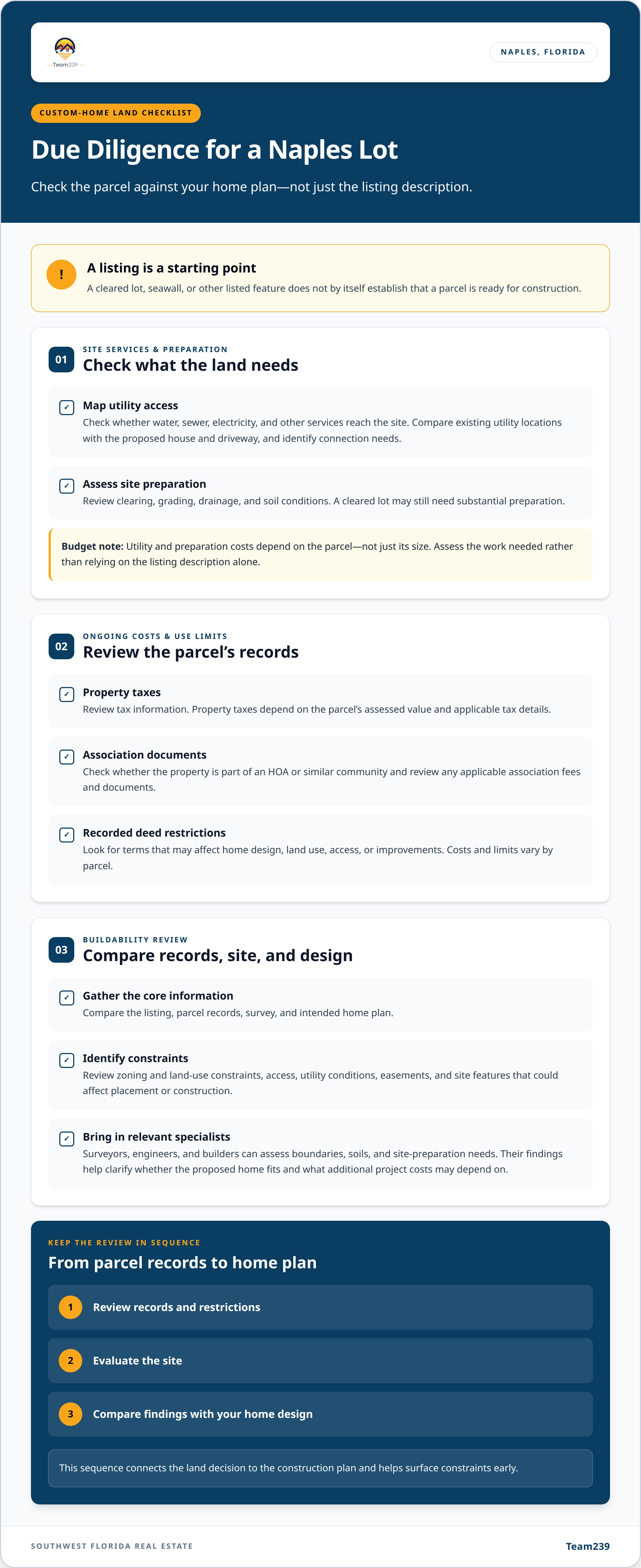
Before committing to a Naples lot, connect the purchase decision to your home’s site requirements. Utility access, recorded restrictions, and physical conditions can all shape the work and expense ahead.
Utilities and Site Preparation
Utility and preparation costs depend on the parcel, not just its size. Key factors include whether water, sewer, electricity, and other services reach the site, as well as connection needs, clearing, grading, drainage, and soil conditions. Even a cleared lot may need substantial preparation.
For a Naples parcel, map existing utility locations against the proposed house and driveway. Then assess the work needed to connect services and prepare the building area. This gives you a more realistic project budget than relying on the listing description alone.
Taxes, HOA Fees, and Deed Restrictions
Property taxes depend on the parcel’s assessed value and applicable tax details. Association fees apply when a property is part of an HOA or similar community, and deed restrictions may shape how owners can use the land. Costs and limits vary by parcel, so include them in your purchase review.
Review the property’s tax information, association documents, and recorded deed restrictions together. Look for terms that affect home design, use, access, or improvements. A Naples lot’s asking price alone won’t show the full financial or design picture.
Verifying Lot Buildability
A real estate professional can help organize a buildability review by comparing the listing, parcel records, survey, and intended home plan. The review should identify zoning and land-use constraints, access, utility conditions, easements, and site features that could affect placement or construction.
For a vacant lot, your buyer’s representative can coordinate transaction questions with relevant specialists, including surveyors, engineers, and builders. These professionals assess boundaries, soils, and site-preparation needs. Their findings help clarify whether your proposed home fits the property and what additional project costs may depend on.
Follow a clear sequence: review records and restrictions, evaluate the site, then compare the findings with your home design before advancing the purchase. For a Naples custom build, this ties the land decision to the construction plan and helps surface constraints early.
Land-use and zoning opportunities
For a Naples custom home, zoning determines which plans may fit a parcel. Compare your intended home and site layout with the property’s land-use designation, recorded restrictions, and physical conditions.
Required permits and approvals depend on the parcel, jurisdiction, and proposed design. Plan for land-use review and building permits, with additional review if site conditions or the project require it.
Start with the proposed home’s use, footprint, height, and placement. Then compare the plans with the parcel’s zoning, setbacks, easements, access, and deed restrictions. A lot that looks suitable in a listing may have constraints that change the design or rule out your preferred layout.
Use: Confirm the parcel’s designated use aligns with a single-family home.
Placement: Map the planned home against boundaries, access, and recorded easements.
Design: Review height, footprint, and exterior plans against applicable zoning and restrictions.
Site conditions: Factor drainage, vegetation, and waterfront improvements into the plan.
Naples properties can differ sharply in setting and site features. For example, a listing at 1693 Bonita Court describes a new 138-foot seawall. That feature can influence the site plan, but it does not establish zoning compliance or approval for a particular home design.
A real estate professional can help organize the purchase review, bringing parcel records together with zoning and land-use considerations for your proposed design. Surveyors, engineers, and design professionals can assess boundaries, site conditions, and plans. Their findings help identify applicable approvals and whether your intended layout fits the lot.
Budget for the land purchase, due diligence, utility connections, site preparation, design, permits, and construction. Total costs depend on parcel conditions, service access, home specifications, and required site work. A vacant lot’s asking price alone won’t represent the full project commitment.
Align your land search with your construction goals through planning support for your Naples land purchase.
Team239
Team239 can help connect your Naples land search with the goals for your future home. Its New Construction Buyer Representation supports buyers evaluating land as part of a new-build purchase, while Residential Resale Representation and Relocation Consulting can support related home-buying or moving decisions.
Turn to Team239 when you’re narrowing parcel options and want your purchase decision to reflect your intended home, location priorities, and transaction needs. A clear conversation about your plans can help focus the search and identify the next steps.
Contact Team239 to discuss your Naples land and home-buying goals.
Turn Your Home Vision Into a Land Search
Before pursuing land for a custom home in Naples, FL, define the experience you want the property to support. Consider how the home will sit on the site, how you’ll use outdoor space, and which location priorities matter most. These choices can focus your search and keep the purchase decision connected to your longer-term plans.
Team239 offers New Construction Buyer Representation for buyers pursuing a new-build purchase, along with Residential Resale Representation and Luxury Property Listing Services. The right support depends on your real estate goals and where you are in the process.
Share your plans and explore a next step with Contact Team239 about Naples land. A clear direction can make your search more purposeful and help you move forward with confidence.
Frequently Asked Questions
What zoning and building rules apply to vacant lots in Naples, FL?
Rules depend on the parcel’s location, land-use designation, and proposed home design. Before proceeding, match your intended use and site plan with applicable zoning standards, building requirements, recorded restrictions, and review processes. For example, a two-story design or larger driveway may affect whether the layout fits. Confirm the requirements for the specific property before purchase and construction planning.
What flood zone, elevation, drainage, and storm-surge risks affect Naples lots?
Flood exposure and drainage conditions vary by property, so assess each lot individually. Review its flood-zone designation, elevation information, drainage patterns, and proximity to water as part of the site evaluation. For a waterfront parcel, consider how shoreline features affect the proposed layout. A qualified professional can interpret site-specific information and explain how it may influence design, access, and construction planning.
Do Naples lots require wetland, environmental, or geotechnical assessments?
Assessment needs depend on the parcel’s conditions and proposed work. Wetland or environmental review may be relevant if vegetation, water features, or other site characteristics raise concerns. Geotechnical work can help evaluate ground conditions for a planned structure. For example, a wooded or low-lying lot may warrant closer review before design decisions. Findings help shape site planning and next steps.
All content on the Naples Florida Real Estate Channel and associated social media platforms is for informational and entertainment purposes only. The owner makes no representations about accuracy or completeness and is not liable for errors, omissions, availability, losses, injuries, or damages arising from display or use. Information may change. Consult Kristin and Jonathan Van Heukelom or another licensed real estate agent for expertise specific to your situation.
What permits and approvals are needed to build a custom home in Naples?
Requirements depend on the parcel, jurisdiction, and proposed design. Plan for land-use review and building permits, with additional review if site conditions or the project require it.
Comments