
Four choices that can help you avoid regret when buying a Florida retirement home
Buying a Florida retirement home before you retire can work, but the decision should fit your future finances and day-to-day needs, not just your current plans. A disciplined approach to avoiding regret when buying a Florida retirement home means weighing whether to buy early, what ongoing costs you can carry, where you want to live, and which type of home suits you.
It’s easy to focus on warm weather or the prospect of a future home near the coast. The more useful step is to test that vision against retirement income, changing needs, access to everyday services, and the responsibilities that come with each property type.
This guide breaks the decision into four parts: when to buy, how to plan for living costs and senior accommodations, how to assess location and services, and how condos, houses, and new builds compare. Use these factors to see what may work for your retirement, now and as your needs evolve.
Table of Contents
1. Should You Purchase A Second House Before You Retire?
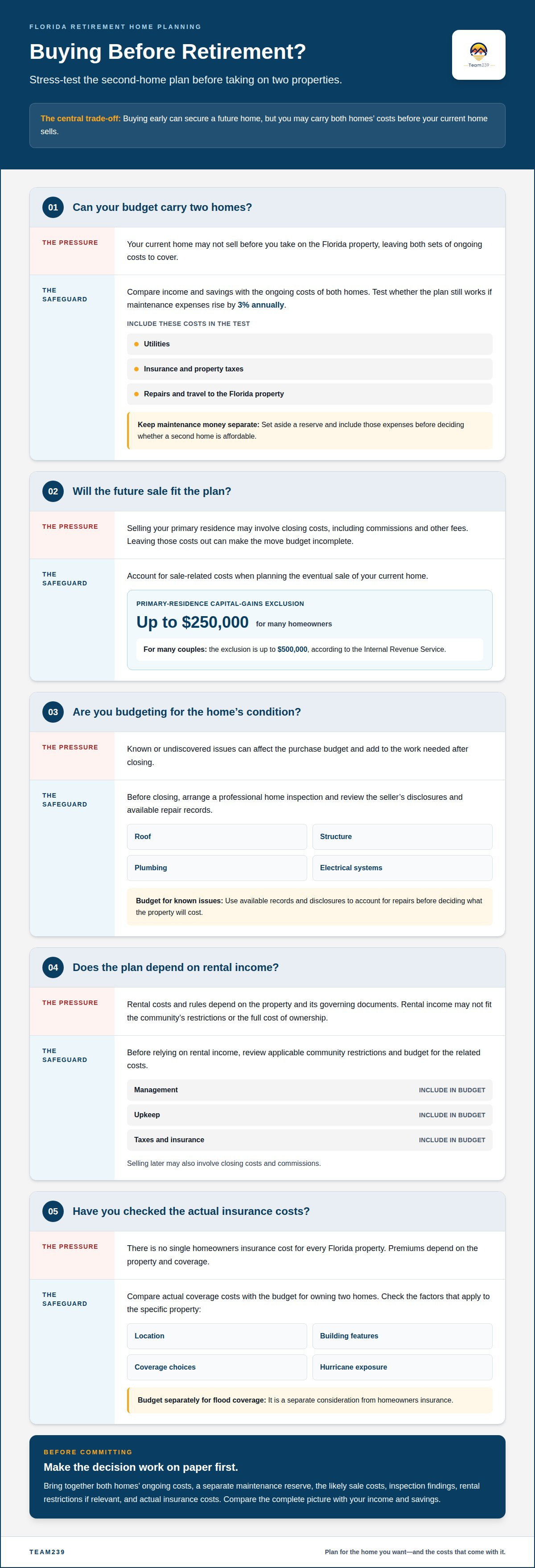
Buying before retirement can secure a future home, but it also means carrying two properties before your current home sells. To reduce the risk of regret, compare your income and savings with both homes’ ongoing costs, then test whether the plan still works if maintenance expenses rise by 3% annually. Include utilities, insurance, taxes, repairs, and travel to the Florida property in that budget.
Set aside a separate reserve for maintenance. Add those expenses to your budget before deciding whether a second home is affordable.
Plan for the eventual sale of your primary residence, too. Home-sale closing costs may include commissions and other fees, so account for them when planning a sale. The Internal Revenue Service says many homeowners can exclude up to $250,000 of capital gains from the sale of a primary residence. For many couples, the exclusion is up to $500,000, according to the Internal Revenue Service.
Before closing, arrange a professional home inspection to assess the roof, structure, plumbing, and electrical systems. Review the seller’s disclosures and available repair records so you can account for known issues in your purchase budget.
Rental costs and rules depend on the property and its governing documents. Before relying on rental income, review applicable community restrictions and budget for management, upkeep, taxes, and insurance. Selling later may also involve closing costs and commissions.
There is no single homeowners insurance cost for every Florida property. Premiums depend on location, building features, coverage choices, and hurricane exposure; flood coverage is a separate budget consideration. Compare actual coverage costs with your budget for owning two homes before committing.
2. Cost of living and senior accommodations
A Florida retirement budget needs more than a purchase figure. Add property taxes, utilities, insurance, transportation, groceries, healthcare, and community fees, then compare the total with expected retirement income. Florida has no state income tax, but that alone doesn’t determine whether a move lowers your overall tax costs. Property taxes and other expenses still shape your monthly budget.
Property tax bills depend on the property and its local assessment. Florida homestead eligibility depends on residency status and other factors, and homestead treatment can affect property tax benefits, creditor protection, and inheritance rights. Include your likely residency plans and property use in your financial planning instead of assuming that owning a Florida home automatically qualifies you for homestead benefits.
Home costs also vary by city, neighborhood, property type, condition, and proximity to services. Compare current listings in Naples, Bonita Springs, Estero, Marco Island, and Fort Myers alongside taxes, insurance, utilities, and community fees. This gives you a more useful comparison than purchase price alone.
Senior accommodations shape both cost and lifestyle. A single-story home can reduce stairs, while a property near healthcare facilities can make appointments easier to manage. Some active adult communities offer on-site healthcare assistance as residents’ needs change. Shared activities can also foster belonging and reduce loneliness. Before buying in a 55+ community, read its HOA rules and include recurring fees in your budget.
When considering a retirement resort, weigh its amenities against the costs and rules. List the services you’ll use, such as social activities or healthcare assistance, and compare them with utilities, community fees, and your preferred lifestyle. If you’re relocating, renting in the area first can help you understand everyday costs before buying.
Estate planning deserves attention, too. A revocable living trust can help simplify estate administration and potentially avoid probate complications involving out-of-state real estate. Review your will, trust, powers of attorney, healthcare directives, and beneficiary designations together. To plan a sale alongside a move, explore luxury property listing services as part of your next-step planning.
To reduce the risk of scams or a regrettable purchase, verify property ownership and review the written terms before sending funds. Compare the contract with property records and your budget, and include an attorney in reviewing legal documents. Clear records and a complete cost comparison support a more informed decision.
Florida property tax bills depend on the property and its local assessment. Retirees may qualify for homestead treatment depending on residency status and other factors. It can affect property tax benefits, creditor protection, and inheritance rights.
3. Choosing a location and assessing access to services
A scenic address can feel exciting, but daily access determines how practical it is. Compare Naples-area neighborhoods by travel time to healthcare, groceries, pharmacies, family, and activities you enjoy. A remote retirement home may require a two-hour drive for basic errands or dinner out. Map routine destinations before choosing, then consider whether the travel fits your health, mobility, and transportation needs. Nearby family and social opportunities can also help you stay connected after relocating.
Which Florida areas have the lowest hurricane, flood, and storm-surge risks? Don’t rely on a citywide label. Compare each property’s flood-zone designation, elevation, drainage, and proximity to the coast or waterways. Storm-surge exposure depends on a location’s specific setting, so compare individual parcels rather than assuming Naples, Bonita Springs, Estero, or Marco Island is uniformly safer.
How can buyers check a Florida home's flood zone, elevation, and storm history? Review property-specific flood-zone maps and elevation information, then examine available storm, repair, and insurance records. Compare those details with the home’s location and the coverage in your budget. A map alone won’t show a property’s full history, so consider the building and surrounding area together.
Use a repeatable route test before deciding. Map the drive from the property to a clinic, grocery store, pharmacy, and a place you’d visit socially. Check whether those destinations are convenient for ordinary routines, not just a vacation stay. For example, compare a home near central Naples with one farther from services, then weigh the extra travel against potential savings and your preferred setting.
Finally, match the location to how you expect to spend retirement. List the activities, healthcare access, family connections, and community resources that matter most. Visit the neighborhood at different times of day and note traffic, noise, and access to everyday services. A clear comparison helps turn an exciting move into a practical long-term choice.
4. Comparing condos, houses, and new builds
To avoid regret when buying a Florida retirement home, compare ownership responsibilities as well as appearance and layout. A condo may suit someone who prefers shared exterior maintenance, but association rules and fees shape the experience. A detached house offers more control, along with responsibility for upkeep. A new build lets you assess a planned layout and features before purchase, so examine the written specifications and contract carefully.
Condo buyers should review the association’s budget, reserve funding, meeting records, fee history, and planned repairs. Ask what regular fees cover and whether owners have faced special assessments. These details make reserve planning a practical part of comparing homes.
Use the same checklist for each property type. Compare maintenance duties, insurance arrangements, accessibility, parking, storage, and restrictions on property use. For a house, account for grounds and exterior care. For a condo, inspect shared areas and understand the association’s responsibilities. For a new build, compare the plans and specifications with the features you expect, and review the purchase contract before signing.
A practical way to avoid regret when buying a Florida retirement home is to test each option against your retirement income and everyday routine. Would you rather manage home upkeep or follow community rules in exchange for shared maintenance? Could recurring association fees fit your budget if they change? Would the new home’s layout suit your needs later? Write down your answers before choosing.
Compare resale homes by their current condition and community obligations; assess new builds through their documented design and contract. Team239 offers New Construction Buyer Representation for buyers weighing a new-build purchase against retirement priorities. Explore new construction buyer representation as you compare your options.
Team239: Residential Resale Representation
Team239 helps retirement-home buyers compare residential resale properties and new construction options through Residential Resale Representation and New Construction Buyer Representation. Turn to the team when you’ve narrowed your priorities and want guidance matching a property to your budget, preferred location, and plans for retirement.
If your move involves relocating to Southwest Florida, Relocation Consulting can help you assess the transition alongside your home search. And if you’re selling a property as part of that move, Luxury Property Listing Services can support that next step. The right path depends on whether you’re buying a resale, considering a new build, or coordinating a sale and relocation.
Contact Team239 to discuss your Florida retirement-home plans.
Turn your priorities into a confident next step
A retirement home should support the life you want to build, not just the vision that first drew you to Florida. Before moving forward, write down your non-negotiables, the trade-offs you can accept, and the questions that still shape your decision. This gives you a clear framework for comparing properties and keeping your priorities in view as new options arise.
Avoiding regret when buying a Florida retirement home starts with making choices that fit your own plans, finances, and preferred pace of life. You don’t need every detail settled at once. A focused conversation can help you clarify what matters most and identify a practical next step for your home search.
Contact Team239 to discuss your plans and explore a path that fits your retirement goals. With a clear direction, you can move ahead thoughtfully and make your next chapter feel like your own.
Frequently Asked Questions
Do Married Couples Need Special Planning For Florida Property?
Yes. Married buyers should decide how the deed names each spouse and how ownership should transfer if one spouse dies or becomes incapacitated. The title structure can affect whether property transfers automatically or probate is required. Couples who live in another state should also account for possible probate proceedings there and in Florida. Coordinate property ownership with existing wills, trusts, and powers of attorney.
What should retirees consider before buying a home in Florida?
Start by deciding whether the home will be a seasonal base or your primary residence, then compare both plans with retirement income and current housing commitments. For example, compare homes in Naples, Bonita Springs, Estero, Marco Island, and Fort Myers based on how often you expect to use them and which community suits your routine. Write down the conditions that would make you pause or proceed.
How do Florida retirement communities compare on healthcare, transportation, and amenities?
Compare communities with a simple scorecard based on the services you’ll actually use. Record travel time to medical appointments, available transportation options, and the amenities included in the community. Then test a typical weekday route from a prospective home to healthcare and essential errands. A community’s activity calendar can also help you assess whether its social opportunities suit your interests and preferred pace.
How much do Florida retirement homes cost by city and region?
Costs vary by city, neighborhood, property type, condition, and proximity to services. Compare current listings in Naples, Bonita Springs, Estero, Marco Island, and Fort Myers alongside taxes, insurance, utilities, and community fees.
Which Florida areas have the lowest hurricane, flood, and storm-surge risks?
Compare individual properties rather than relying on a citywide label. Review each property’s flood-zone designation, elevation, drainage, proximity to the coast or waterways, and available storm, repair, and insurance records.
Comments