
Collier County Property Tax: How Much Home Buyers May Pay

That’s a useful starting point, but the property’s location, taxing districts, assessed value, and exemptions can all affect what a buyer pays. This Collier County property tax guide for home buyers explains how to estimate the bill and what can change it.
It’s reasonable to want a clear tax estimate before committing to a home. Look beyond the seller’s current bill: a sale can change the property’s assessed value, and the buyer’s exemptions may differ from the seller’s.
Here, you’ll learn how Florida property taxes are calculated, why rates vary across Collier County, and how local assessments affect the total. You’ll also learn how the homestead exemption works, when to apply, and what to include when estimating ongoing housing costs.
Table of Contents
Florida homestead exemption eligibility and filing
Florida home buyers may qualify for the homestead exemption if the property becomes their permanent residence. Other exemptions may apply based on age, income, or veteran status.
Eligibility and Filing
To qualify, occupy the home as your permanent residence by January 1 of the tax year you’re applying for. Check the current filing requirements before submitting the standard Florida application. Eligible homeowners may also pre-file after March 1 for the next year.
The standard exemption reduces taxable value in two parts. The first $25,000 applies to all property taxes, including school taxes. A second $25,000 applies to assessed value between $50,000 and $75,000, excluding school taxes. A qualifying owner-occupant may receive up to $25,000 in assessed-value exemption, except for special-benefit assessments, according to The Florida Senate.
A homestead exemption from a previous home doesn’t automatically transfer when you move. Apply again for your new Collier County residence. Filing on time matters because the exemption can reduce the taxable value used to calculate annual property taxes.
Senior and Veteran Exemptions
Additional exemptions may reduce taxes for qualifying seniors and veterans. Collier County’s additional senior exemption is for homeowners aged 65 or older who meet income requirements; the 2026 household income limit is $38,686. Florida homeowners with 100% disability as veterans may qualify for a full exemption on a homesteaded residence, while the listed exemption for partial disability is $5,000. These exemptions depend on eligibility, so age, income, disability status, and homestead status affect which relief may apply.
Save Our Homes Assessment Cap
The Save Our Homes cap limits annual assessed-value increases on a homesteaded property to 3%. It works alongside the exemption: the exemption lowers taxable value, while the cap limits how quickly assessed value can rise in later years. For buyers, this means the seller’s tax history may not reflect the buyer’s future assessment after a purchase. Establishing a new homestead is therefore an important part of planning for property taxes over time.
How Much Is Property Tax in Collier County?
The amount depends on assessed value, exemptions, and the millage rate for the property’s district. To estimate the bill, distinguish taxable value from assessed value and review the current tax record.
Property Assessments and Taxable Value
Assessed value is the value used to calculate Florida property tax, while taxable value reflects applicable exemptions. The distinction matters because exemptions reduce the amount subject to the combined millage rate. Eligible Florida homeowners may receive a homestead exemption that decreases taxable value by as much as $50,000, according to the Florida Department of Revenue. The Florida Senate states that a qualifying owner-occupant may receive an exemption of up to $25,000 in assessed value, except for special-benefit assessments.
For a homesteaded property, the Save Our Homes cap limits annual assessed-value increases to 3%. This cap does not set a home’s market value or freeze its taxable value. Instead, it limits how quickly assessed value can rise over time. After a sale, the new owner’s assessment may differ from the seller’s, so the seller’s tax bill is not a reliable future-cost estimate by itself.
Finding Current Bills and Assessed Values
Find the current tax bill through the Collier County Tax Collector and the assessed value in the Collier County Property Appraiser’s property records. Match the parcel to the home, then review its value, exemptions, and district information. This is a starting point, not a prediction of your future bill.
The Property Appraiser determines market value as of January 1 each year. Collier County mails TRIM notices in mid-August with proposed assessed values and taxes. If an owner disputes an assessment, the Value Adjustment Board petition deadline is typically about 25 days after the notice is mailed. The petition fee is about $15 per parcel.
Late property taxes accrue interest at 18% per year. Reviewing the parcel record, proposed value, exemptions, and applicable district helps buyers understand what drives the bill and whether an assessment issue may need attention.
Collier County property tax rates and taxing districts
A home’s location determines which local millage rates and assessments contribute to its property tax bill. Naples, Marco Island, Everglades City, and unincorporated areas have different combined rates.
Combined Millage Rates and Local Variations
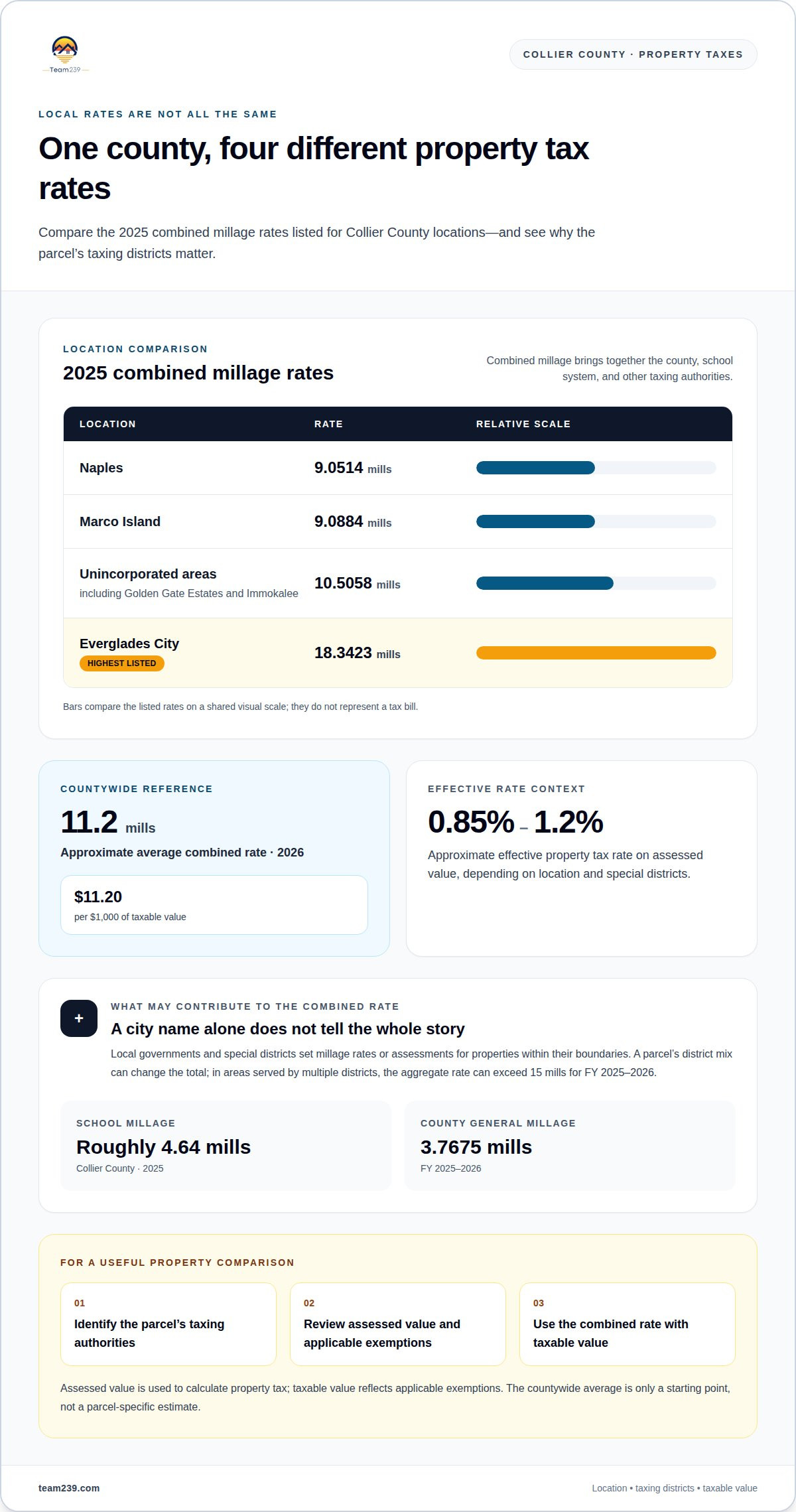
Combined millage is the total rate charged by the county, school system, and other taxing authorities. In 2026, Collier County’s approximate average combined rate is 11.2 mills, equal to $11.20 per $1,000 of taxable value.
Local figures show why a county average is only a starting point. For 2025, Naples had a total rate of 9.0514 mills, Marco Island 9.0884 mills, and unincorporated areas including Golden Gate Estates and Immokalee 10.5058 mills. Everglades City was listed at 18.3423 mills.
Collier County’s 2025 school millage was roughly 4.64 mills. The county’s general millage rate was 3.7675 mills for FY 2025-2026. These rates combine with other applicable levies, so homeowners comparing properties should use each parcel’s location and taxing districts.
City and Special District Taxing Authorities
Taxing authorities are local governments and districts that set millage rates or assessments for properties within their boundaries. Cities have different combined rates, and special districts can add costs in specific neighborhoods.
In areas served by multiple districts, the aggregate property tax rate can exceed 15 mills for FY 2025-2026. The parcel’s district mix matters as much as its city label.
Collier County’s effective property tax rate typically ranges from approximately 0.85% to 1.2% of assessed value, depending on location and special districts. To compare homes, identify each property’s taxing authorities, then apply their combined rate to taxable value. The countywide average cannot capture every neighborhood’s full tax picture.
Estimated property taxes for home buyers
A reliable Collier County property tax guide for home buyers starts with taxable value and the property’s combined millage rate. Use an estimate to compare likely ownership costs, not as a guarantee of the final bill. The seller’s current tax bill offers context, but may not reflect what you’ll owe after reassessment.
That calculation applies the rate to $350,000 in taxable value.
These examples show why both the purchase value and the property’s location matter. The actual amount also depends on applicable district rates, exemptions, and assessments.
Florida assesses market value as of January 1 each year. A purchased home is reassessed to its sale price on January 1 after the sale, so the former owner’s tax bill may not reflect the buyer’s future amount. Florida property taxes are prorated between buyer and seller at closing because taxes are paid in arrears for the previous year. That closing adjustment settles each party’s share of the applicable bill, but it doesn’t set the buyer’s later annual tax.
The estimates in this Collier County property tax guide for home buyers are planning benchmarks. For a practical estimate, account for the expected purchase value, the home’s taxing districts, any exemption you expect to qualify for, and community assessments. Consider closing proration separately. This gives you a clearer view of recurring property taxes than relying on the seller’s previous bill alone.
Planning a purchase around these costs? Explore home-buying support as you evaluate properties and their ongoing tax obligations.
Team239: New Construction Buyer Representation
Team239 helps home buyers navigate residential resale and new construction purchases across Southwest Florida. Turn to its New Construction Buyer Representation when comparing communities, evaluating home options, and weighing how location-specific taxes and assessments fit your purchase planning. For resale properties, Residential Resale Representation supports buyers as they assess homes against their priorities. This guidance connects property choices with the practical costs covered in this guide, without treating a tax estimate as a substitute for the property’s actual bill.
For buyers relocating to the area, Relocation Consulting can help connect the home search with broader moving decisions. Sellers can also use Luxury Property Listing Services when preparing a home for market. Contact Team239 to discuss your real estate plans.
Make Your Next Home Decision with Clarity
Use this Collier County property tax guide for home buyers as a planning framework, not just a way to estimate one bill. Next, consider how ownership costs relate to the home’s location, features, and fit for your daily life. A property that looks right on paper should also fit your broader purchase plans.
As you narrow your options, keep your priorities in view. Consider how each home supports your plans, which tradeoffs you can accept, and how recurring costs fit your budget alongside other ownership expenses. Clear priorities make it easier to compare properties without letting one appealing feature overshadow the full picture.
Team239 can help you move from research to a focused home search and purchase plan. Bring your goals and the questions you’re weighing into the conversation, then shape your next steps with professional real estate guidance. Contact Team239 about your home purchase, and take the next step with a clearer sense of what matters to you.
Frequently Asked Questions
When Are Property Taxes Due?
Collier County property taxes are generally due by March 31, with early-payment discounts for payments made earlier. The annual tax bill typically arrives in November, and the discount begins around November 1. Payments made in December, January, or February receive discounts of 3%, 2%, or 1%, respectively. A March payment receives no early-payment discount, so check the bill for its specific payment instructions.
Why did my taxes go up after I bought?
Your tax bill may rise because the property’s assessed value can change after a sale, and the previous owner’s exemptions or assessment limits may not carry over. For example, the prior owner may have had a homestead exemption that you haven’t applied for. The new bill may also reflect local taxing districts or special assessments that affect the total owed.
How are Collier County property taxes calculated for homeowners?
Collier County calculates property taxes by applying the combined millage rate to taxable value. Taxable value starts with assessed value, then accounts for applicable exemptions; district rates and special assessments can add to the total. For example, a parcel in a community with a CDD assessment may have costs beyond the millage calculation. Review the parcel’s tax record to understand the components of its bill.
What are the current Collier County property tax rates and millage rates?
Rates vary by location and tax year. For 2025, listed total millage rates were 9.0514 mills in Naples, 9.0884 on Marco Island, 10.5058 in unincorporated areas, and 18.3423 in Everglades City. Collier County’s approximate average combined rate for 2026 is 11.2 mills. Use the property’s location and tax year when comparing rates, since a county average won’t match every parcel.
What are Florida homestead exemption eligibility rules and application deadlines?
To qualify for Florida’s homestead exemption, occupy the home as your permanent residence by January 1 of the tax year you’re applying for. Submit form DR-501 by March 1 of the following year. If you move, the exemption doesn’t automatically transfer to your new Collier County home, so file a new application for that residence. Eligibility and filing status affect the exemption applied to taxable value.
How do Collier County property taxes change after a home purchase and reassessment?
After a purchase, the Collier County Property Appraiser reassesses the home to its sale price on January 1 after the sale. That new assessment can make the buyer’s bill differ from the seller’s previous bill, particularly if the seller had an exemption or assessment cap. At closing, Florida property taxes are prorated between buyer and seller for the applicable period, but that adjustment isn’t the buyer’s future annual bill.
Comments