
Average Cost of Utilities in Fort Myers by Month and Year

Utility costs and electricity rates in Fort Myers can vary from national averages.
Those figures are useful benchmarks, not a prediction of every household’s bill. Your actual costs depend on electricity and water use, as well as the internet and mobile services you choose. This article explains how the estimates are calculated, breaks down monthly and annual costs for key utilities, and compares Fort Myers with national averages. You’ll also see which assumptions shape the totals, helping you build a more realistic household budget.
Table of Contents
Average monthly and annual electric bills in Fort Myers
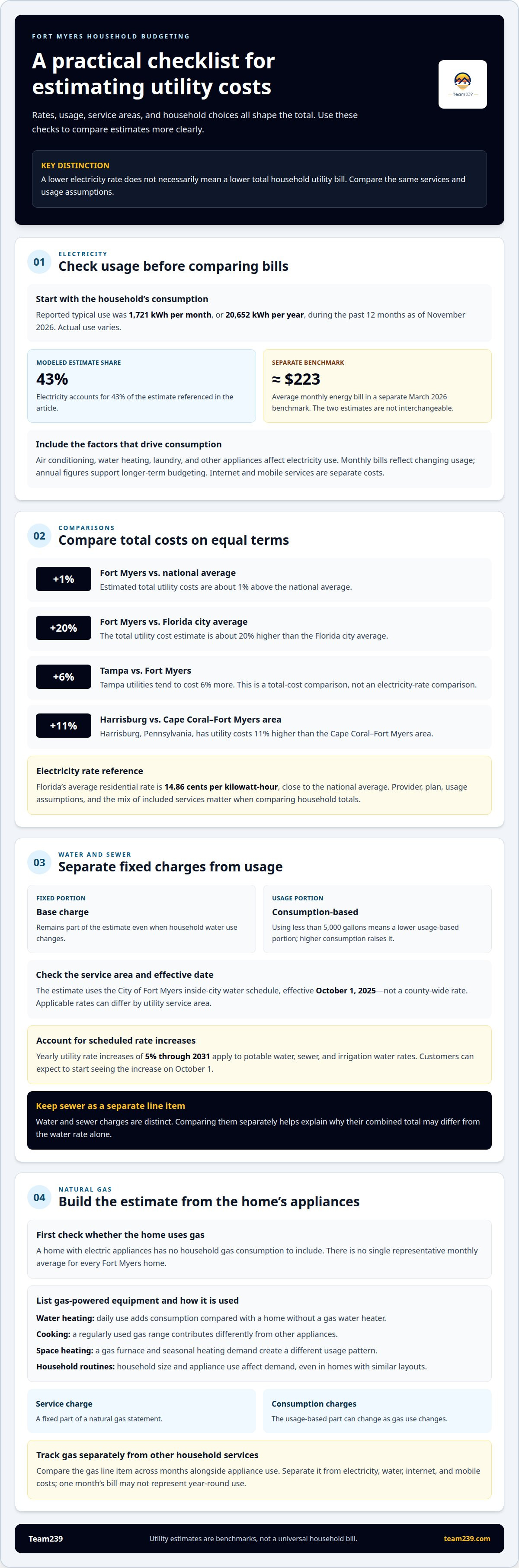
Electricity accounts for 43% of that estimate. A separate March 2026 benchmark puts the average monthly energy bill at about $223. These figures use different benchmarks, so they aren’t interchangeable.
Electricity costs depend on both the rate and household usage. Air conditioning, water heating, laundry, and other appliances shape consumption. Typical reported use was 1,721 kWh monthly, or 20,652 kWh yearly, during the past 12 months as of November 2026.
Annual figures help with longer-term budgeting, while monthly bills reflect changing usage. Internet and mobile services add separate costs.
What is the average monthly trash and recycling fee in Fort Myers? What is the average total monthly utility cost for a Fort Myers household? For a broader household budget, the average cost of utilities in Fort Myers excludes internet and mobile services from the modeled total.
Fort Myers utility costs compared with the national average
Fort Myers utility costs are estimated at about 1% above the national average. The estimate is about 20% higher than the Florida city average. These comparisons cover total utility costs, not electricity alone. They can help with broad budgeting, but the total depends on which services and usage assumptions are included.
Electricity rates tell a different story. Florida’s average residential rate is 14.86 cents per kilowatt-hour, which is close to the national average.
Nearby cities offer another useful reference. Tampa’s utilities tend to cost 6% more than Fort Myers. These are total-cost comparisons, so they shouldn’t be read as a direct comparison of electricity rates alone. Household consumption and the mix of services affect the overall estimate.
Harrisburg, Pennsylvania, has utility costs 11% higher than the Cape Coral-Fort Myers area. That comparison provides regional context, but household totals still depend on individual usage and included services.
Electricity rates vary among Florida utilities and cities. The provider, plan, and usage assumptions all matter. Compare rates on the same per-kilowatt-hour basis, then consider the full utility estimate. A lower electricity rate alone does not guarantee a lower household total.
City water rates and usage assumptions
This structure separates the fixed charge from the amount tied to consumption. The base charge remains part of the estimate even when household use changes. For example, a home using less than 5,000 gallons would have a lower usage-based portion, while higher consumption raises it. The estimate is a benchmark, not a universal household bill.
Sewer is a separate line item. Comparing water and sewer charges separately helps explain why their combined total can differ from the water rate alone.
Do Fort Myers utility costs differ between city and county service areas? They can, because the applicable rate schedule depends on the utility service area. The figures here use the City of Fort Myers inside-city water schedule, not a county-wide rate. Fort Myers City Council approved yearly utility rate increases of 5% through 2031, applying to potable water, sewer, and irrigation water rates. Customers can expect to start seeing the increase on October 1, so the schedule’s effective date matters when comparing bills.
What is the average monthly natural gas bill in Fort Myers?
Fort Myers households don’t all have a natural gas bill. The monthly amount depends first on whether a home uses natural gas at all. A home with electric appliances has no household gas consumption to include. A home using gas for cooking, water heating, or space heating has a different cost profile. A useful estimate starts with the home’s fuel and appliances, not a citywide average.
Usage is the main variable. A gas water heater used every day adds consumption that a home without one avoids. A gas range used regularly contributes differently from gas heating used during cooler periods. Household size and routines also shape demand. For example, two homes with similar layouts may have different bills if one uses gas for several appliances and the other uses it only for cooking.
The bill structure matters, too. A natural gas statement can include a service charge and charges based on the amount consumed. Because fixed and usage-based portions serve different purposes, a change in consumption may not affect the full bill equally. To build a household budget, separate gas from electricity, water, internet, and mobile costs. This makes it easier to see which appliances drive fuel use.
For a Fort Myers home, start by identifying gas-powered equipment, then consider how often each appliance runs. A gas furnace creates a different usage pattern from a gas stove used for meals. Seasonal use can also shift the monthly total, especially when heating demand changes. These factors explain why a single average cannot describe every home. Compare the gas line item across months alongside appliance use, rather than treating one bill as a year-round estimate.
There is no single representative monthly average because bills depend on whether a home uses natural gas, its appliances, and household usage.
Team239
Team239 helps buyers and sellers make informed residential real estate decisions across Southwest Florida. Utility estimates can add useful context when you’re weighing a home’s ongoing household costs, alongside its location, features, and fit. For a move to the area, Relocation Consulting can help you understand the local housing landscape. Buyers can work with the team on residential resale properties or new construction, while sellers can use luxury property listing services when appropriate.
These real estate services support a broader housing decision; they don’t replace a utility provider’s bill or rate estimate. If you’re planning a move, buying, or preparing to sell in Southwest Florida, contact Team239 to discuss your real estate needs.
Turn your housing plans into a confident next step
Use the average cost of utilities in Fort Myers as one part of your broader housing decision. A home’s ongoing expenses matter alongside its layout, location, and fit with your plans. Bringing these priorities together can help you focus on properties that suit your day-to-day life, not just your first impressions.
Team239 supports buyers and sellers with Residential Resale Representation, New Construction Buyer Representation, and Luxury Property Listing Services. Whether you’re moving to the area, choosing between a resale home and new construction, or preparing a property for sale, align your real estate decisions with the needs you’ve identified.
Ready to discuss your next move? Contact Team239 about your move and take the next step with a clear sense of what matters to you.
Frequently Asked Questions
How are these estimates calculated?
They combine assumed usage with applicable rates and service charges. The modeled Fort Myers total uses 1,000 kWh of electricity and 5,000 gallons of water, then adds estimated water, sewer, and trash charges. Treat it as a defined benchmark, not a complete bill for every household: internet and mobile services are separate, and changing the usage assumptions changes the estimate.
Why might my actual bill differ?
Your bill can differ because your household’s consumption, service area, and applicable rate schedule may not match the estimate’s assumptions. For example, higher electricity use changes the energy charge, while water use affects its volumetric charge. Appliances and household routines also shape consumption. Bills may include services or charges excluded from a modeled estimate, so compare the same billing period and service categories before interpreting the difference.
What is the average monthly electric bill in Fort Myers, Florida?
These figures use different benchmarks and shouldn’t be treated as the same measurement. For a practical budget, match the figure to your expected electricity use and distinguish an energy-bill average from an estimate based on a specific usage assumption.
What is the average monthly water and sewer bill in Fort Myers?
The water estimate assumes 5,000 gallons, and the sewer estimate uses its own listed charge at modeled usage. These amounts represent separate service components. A household’s combined total changes with water consumption and the rate schedule that applies to its service area.
How do Fort Myers utility costs vary by household size and home size?
Household and home size affect costs mainly through consumption, not through a universal per-person or per-square-foot amount. More occupants can mean more hot water, laundry, and appliance use. A larger home may require more cooling, depending on its equipment and use. For instance, a household that runs air conditioning longer will use more electricity than one with lower cooling demand, even at the same rate.
How do Fort Myers utility costs compare with the Florida and U.S. averages?
Estimated total utility costs in Fort Myers are about 1% above the national average and 20% above the Florida city average. Total utility comparisons include more than electricity, so compare like-for-like services and usage when assessing household budgets.
Comments