
Pros and Cons of Living in Naples, Florida: The 2026 Insider’s Perspective

With the average Naples homeowner now paying approximately $9,600 annually for insurance, the cost of paradise is officially under the microscope. You're likely balancing the dream of Gulf sunsets against the reality of rising premiums and "Season" congestion. Weighing the pros and cons of living in naples florida in 2026 is no longer just about sunshine; it's about mastering a complex financial ecosystem that has changed significantly in the last twenty-four months.
We agree that the confusion over HOA vs. CDD fees and new condo regulations can be a major hurdle for even the most savvy buyers. This article promises a transparent, data-driven breakdown of the lifestyle, from new construction insurance savings to the shifting single-family market. We'll analyze the 2026 financial landscape, validate the undeniable lifestyle perks, and provide a precise framework for selecting the right neighborhood for your long-term goals.
Table of Contents
The 2026 Naples Real Estate Market: Pricing vs. Value
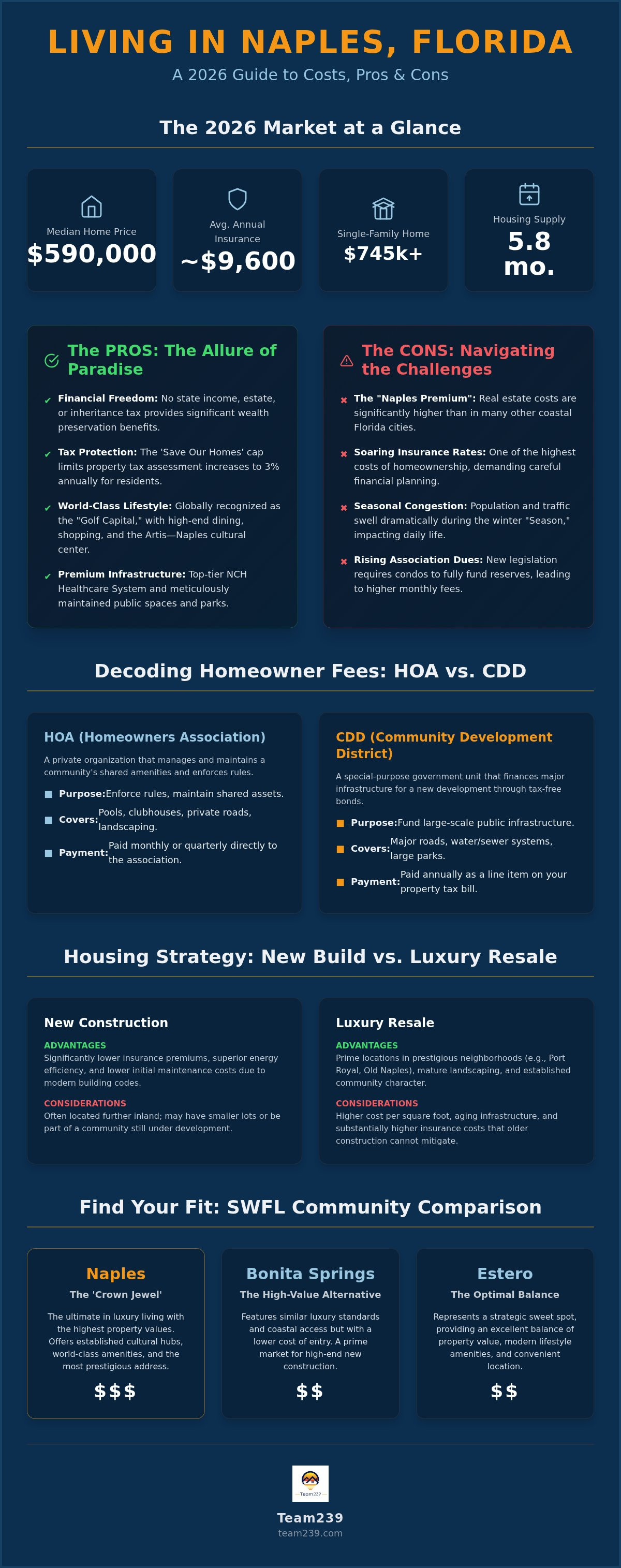
The 2026 real estate market in Naples is a study in segmentation. While the overall median home price reached $590,000 in July 2026, single-family homes have climbed to a range between $745,000 and $750,000. This pricing reflects the "Naples Premium," a value proposition built on limited coastal land and consistent demand from high-net-worth buyers. For a comprehensive Overview of Naples, Florida, you'll see a city that has evolved from a quiet retreat into a global luxury destination. Inventory has tightened to 5.8 months of supply, creating a balanced environment where sellers must be strategic and buyers have room to negotiate on specific property types. Understanding these market shifts is essential when evaluating the pros and cons of living in naples florida today.
Current inventory trends favor buyers in the mid-tier bracket, particularly those looking for properties between $600,000 and $900,000 where supply is slightly more fluid. The rental market remains a viable "test drive" option, though seasonal demand keeps rates high. High-end rentals in zip codes like 34102 and 34108 often book out a year in advance, reflecting the area's enduring appeal for those not yet ready to commit to a permanent deed.
Luxury Resale vs. New Construction
Established neighborhoods like Port Royal or Old Naples offer prestige, but they often come with a higher cost per square foot and aging infrastructure. In contrast, 2026 buyers are gravitating toward new builds for their superior energy efficiency and lower long-term maintenance. Modern building codes also provide significant insurance advantages that older resales simply cannot match. If the Naples price point feels too steep for your current strategy, many are looking at new construction homes Bonita Springs as a high-value alternative with similar luxury standards and lower entry costs.
Condo Living: Amenities vs. Expenses
North Naples has seen a surge in high-rise luxury developments that offer "lock and leave" convenience. These resort-style amenity packages often include private beach clubs, concierge services, and wellness centers. However, this lifestyle comes with a financial trade-off. The 2026 condo market is a balance of convenience and rising association costs. Recent legislation requiring fully funded structural reserves has pushed monthly dues higher, particularly in older buildings. When assessing the pros and cons of living in naples florida, you must factor in these mandatory reserve funds alongside the lifestyle benefits of a maintenance-free home.
The Pros: Why Naples Remains the 'Crown Jewel' of SWFL
Naples isn't just a destination; it's a strategic lifestyle choice. For many high-earning professionals and retirees, the lack of a state income tax in 2026 remains a primary driver for relocation. This financial freedom, paired with a reputation as one of Florida's safest cities, creates a secure environment for both families and assets. When evaluating the pros and cons of living in naples florida, the city's infrastructure often tips the scales. From the top-tier NCH Healthcare System to the meticulously manicured public spaces, the attention to detail is visible on every corner.
Culture thrives here in a way that rivals much larger metropolitan hubs. The cultural trifecta of Fifth Avenue South, Third Street South, and Artis-Naples provides a sophisticated blend of high-end dining, boutique shopping, and world-class performing arts. These areas don't just offer entertainment; they serve as the social heartbeat of the community, fostering a sense of belonging that is rare in many coastal towns.
The Florida Tax Advantage
Living in Collier County offers specific protections for primary residents. The Homestead Exemption provides a significant reduction in taxable value, while the 'Save Our Homes' cap ensures property tax stability by limiting annual assessment increases to 3% or the CPI. This is particularly vital for long-term residents facing rising market values. When you analyze the cost of living data for Naples, you'll see that while housing costs are higher, the absence of estate and inheritance taxes in 2026 provides a massive net benefit for wealth preservation.
Outdoor and Lifestyle Infrastructure
Naples is famously known as the golf capital of the world. Residents enjoy access to a density of private and public courses that is unmatched globally. Beyond the greens, the 2026 completion of local pier and park renovations has restored full beach access, ensuring the coastal experience remains a top priority. Whether you're interested in the social scene at a private club or the quiet beauty of the Everglades, the southwest florida lifestyle offers a diverse range of activities. Mastering the pros and cons of living in naples florida starts with experiencing this infrastructure firsthand. If you're ready to explore these benefits, our relocation consulting services can help you identify the perfect community.
The Cons: Navigating the Challenges of Coastal Living
While the lifestyle benefits are undeniable, mastering the pros and cons of living in naples florida requires a clear-eyed look at the logistical friction points. The most significant hurdle in 2026 is the rising cost of homeowners insurance. Premiums now average approximately $9,600 annually for many residents. This isn't just a flat fee; it's a variable influenced by elevation, age of construction, and specific proximity to the Gulf. Beyond the balance sheet, residents must navigate the environmental reality of high humidity and the annual rhythm of hurricane preparedness. Managing these variables is essential for protecting both your property and your peace of mind.
Then there's the phenomenon known as "The Season." From January through April, the local population swells as part-time residents return. This leads to noticeable inflation in service costs across the board. Whether you're booking a home maintenance contractor or securing a table at a top-tier restaurant on Fifth Avenue, expect longer lead times and premium pricing. Even basic errands require more strategy during these months. Understanding the pros and cons of living in naples florida means accepting that the city's energy and economy are tied to these seasonal cycles.
The 2026 Insurance Market Outlook
The insurance market is finally showing signs of stabilization as newer building codes implemented post-2023 begin to influence carrier appetite. Understanding the distinction between AE and VE flood zones is critical for your budget. VE zones carry a high-velocity wave action designation that can triple your flood insurance costs compared to an AE zone. To verify current exemptions and assessed values for a specific parcel, the Collier County Property Appraiser is an essential resource for your due diligence. 2026 buyers should prioritize homes with updated wind mitigation features to save on premiums.
Managing 'The Season' and Traffic
Traffic congestion during the winter months is a reality, particularly along the US-41 and I-75 corridors. You don't have to stay stuck in gridlock, though. Savvy residents often pivot to "quiet" corridors in North Naples or the Estero border to bypass the most intense bottlenecks. Living here year-round offers a unique reward. The "off-season" provides a peaceful, unhurried version of paradise with wide-open beaches and no-wait dining. It's during these quieter months that the true value of the Naples lifestyle becomes most apparent to those who call it home full-time.
Hidden Costs: Understanding HOA and CDD Fees
The sticker price of a home is rarely the final word on your monthly budget in Southwest Florida. To truly master the pros and cons of living in naples florida, you must look beyond the mortgage at the layered fee structures common in gated communities. In 2026, Homeowners Association (HOA) fees cover everything from basic landscaping and cable to 24/7 manned security and high-end club maintenance. These fees vary wildly. Entry-level communities often start between $300 and $500 per month, while ultra-luxury enclaves can exceed $2,000. Calculating the "true" monthly cost requires auditing these inclusions against what you'd otherwise pay out-of-pocket for utilities and security.
Condo owners face an even more complex landscape. As of January 1, 2026, Florida law requires older buildings to fully fund structural reserves. This has triggered a wave of special assessments and increased monthly dues to meet milestone inspection requirements. If you're considering an established high-rise, reviewing the association's reserve study isn't just a suggestion; it's a financial necessity. These costs are a significant factor when weighing the pros and cons of living in naples florida, as they directly impact your long-term carrying costs and resale value.
HOA vs. CDD: What's the Difference?
Many buyers confuse HOA fees with Community Development District (CDD) fees. Think of the HOA as a service fee for daily operations. In contrast, a CDD is a long-term infrastructure bond used to build the community's roads, utilities, and amenities. These fees typically range from $1,500 to $4,000 annually and appear as a non-ad valorem assessment on your Collier or Lee County tax bill. While the bond portion eventually pays off, the operations and maintenance component remains. Evaluating the value of master-planned amenities against these costs is critical for fee-efficiency.
Spotting Value-Oriented Communities
You don't always have to pay a premium for security and style. Some neighborhoods maintain lower HOA fees by offering "a la carte" amenities rather than bundled packages. Be particularly cautious with "bundled golf" communities. While they offer guaranteed tee times, the annual carrying costs are significantly higher regardless of how often you play. Because luxury homes for sale in Naples FL often feature these complex layers, extra due diligence on fee disclosures is mandatory. If you want a transparent audit of a specific community's financial health, our relocation consulting experts can break down the ledger for you.
Naples vs. Surrounding Areas: Finding Your Sweet Spot
Choosing a home in Southwest Florida often involves a choice between the prestige of a Naples address and the value found just across the county line. When you evaluate the pros and cons of living in naples florida, it's helpful to look at neighbors like Bonita Springs and Estero. Bonita Springs offers a "more house for your dollar" proposition. It frequently provides larger lots or newer renovations at a price point that would only secure a smaller condo in Old Naples. This makes it a top-tier alternative for those who want proximity to the Gulf without the full Naples premium.
Estero has emerged as the 2026 hub for families. With the expansion of shopping infrastructure like Coconut Point and the proximity to Florida Gulf Coast University, it offers a high-energy, suburban feel that appeals to a younger demographic. On the other end of the spectrum, Marco Island represents the ultimate boating lifestyle. While it carries an even higher premium than mainland Naples, the direct Gulf access from your backyard is a trade-off many are willing to make. For most, the final verdict depends on lifestyle goals. Naples is worth the premium if you value world-class dining and a specific brand of coastal elegance, but the surrounding areas are closing the gap in quality of life.
The Lee County vs. Collier County Tax Split
The financial landscape changes the moment you cross the border. Collier County generally maintains a lower property tax millage rate compared to Lee County. However, because median home prices in Naples are higher, your total tax bill may still be larger than in Bonita or Estero. School districts also play a vital role in resale value. Naples' districts often carry a national reputation that bolsters long-term property appreciation, though Lee County schools in the Estero area are seeing significant investment. For a deeper dive into these regional nuances, check our guide on moving to southwest florida.
Next Steps for Your Relocation
Navigating these choices requires more than just a search engine. A local Realtor is essential for uncovering the specific fee and insurance disclosures that vary from street to street. We specialize in providing custom cost-of-living comparisons that go beyond the surface. We help you audit the financial health of HOAs and decode CDD bonds before you sign a contract. This ensures you understand the full pros and cons of living in naples florida before making a commitment. Ready to find your place in the sun? Contact Team239 for a personalized 2026 Naples relocation consultation.
Securing Your Future in the Crown Jewel
Living in Southwest Florida is a strategic decision that goes beyond the allure of white-sand beaches. Success in the 2026 market requires balancing the high-value lifestyle against the evolving insurance landscape and complex community fee structures we've analyzed. We've explored the pros and cons of living in naples florida, highlighting that while the "Naples Premium" remains significant, it's supported by unmatched safety, state tax advantages, and cultural depth. Whether you're targeting new construction to mitigate insurance costs or exploring the value in nearby Bonita Springs, your move requires local precision.
Kristin and Jonathan Van Heukelom bring over 12 years of local market data analysis to every transaction. As specialists in resort-style communities and luxury new construction, they ensure you don't just find a house, but a sustainable financial asset. Don't navigate these variables alone. Download the 2026 Naples Relocation & Cost-of-Living Guide to start your journey with a strategic partner by your side. Your version of paradise is within reach, and we're ready to help you secure it with confidence.
Frequently Asked Questions
Is it expensive to live in Naples, Florida compared to other Florida cities?
Naples is consistently ranked as one of the most expensive markets in the state. With median single-family home prices reaching $750,000 in mid-2026, the entry point is significantly higher than cities like Tampa or Orlando. You're paying for the "Naples Premium," which includes elite safety ratings and world-class infrastructure. While housing is a major investment, the lower property tax millage rate in Collier County helps balance the total cost of ownership over time.
How much are property taxes in Naples, FL for a $1.5 million home?
For a $1.5 million property, your annual property taxes will be approximately $16,650 based on the 2025-2026 millage rate of 11.05 mills. This figure assumes the property is assessed at its full market value. If the home is your primary residence, you can apply for the Homestead Exemption to lower the taxable value. It's vital to consult the Collier County Property Appraiser to understand how a recent sale will trigger a reassessment of the property's value.
What is a CDD fee and how long do I have to pay it?
A Community Development District (CDD) fee is a non-ad valorem assessment used to finance the infrastructure of master-planned communities. The bond portion of the fee typically lasts between 20 and 30 years, after which it drops off your tax bill. However, the operations and maintenance (O&M) portion of the CDD is a permanent cost. In 2026, most Naples residents in these districts pay between $1,500 and $4,000 annually for these shared improvements.
Do I really need flood insurance if I'm not directly on the Gulf?
Yes, flood insurance is a strategic necessity even if you're miles from the coastline. Southwest Florida's flat topography means that heavy tropical rainfall can cause localized flooding far from the Gulf. Lenders require coverage if the home is in a high-risk zone, but many residents still carry private policies for peace of mind. Evaluating these coverage costs is one of the key pros and cons of living in naples florida for budget-conscious buyers.
What is the average HOA fee for a gated community in Naples?
Monthly fees vary based on the level of amenities and security provided. For entry-level gated communities, expect to pay between $300 and $500 per month. Mid-tier communities with resort-style pools and clubhouses usually range from $500 to $900. If you're looking at luxury golf communities, fees often sit between $800 and $1,800. Ultra-luxury high-rises or exclusive enclaves can easily exceed $2,000 per month to cover specialized concierge services and mandatory structural reserves.
How does 'Season' actually affect daily life for year-round residents?
"Season" runs from January through April and fundamentally changes the rhythm of the city. Year-round residents plan their days around traffic peaks on US-41 and I-75 and make dinner reservations weeks in advance. You'll also notice a temporary spike in the cost of local services like landscaping or home repairs as demand peaks. The trade-off is the vibrant energy and world-class events that only happen when the population swells during these cooler months.
Are there tax breaks for retirees moving to Naples in 2026?
Florida's tax structure is exceptionally friendly to retirees in 2026. The state has no income tax, which means your Social Security, 401(k) distributions, and pensions are fully protected. There are also no estate or inheritance taxes to worry about. Additionally, primary residents benefit from the Homestead Exemption, which reduces the assessed value of your home. A measure to increase this exemption further will be on the Florida ballot in November 2026 for additional potential savings.
What is the 'Save Our Homes' cap and how does it benefit new buyers?
The 'Save Our Homes' cap limits the annual increase in the assessed value of a primary residence to 3% or the percent change in the Consumer Price Index, whichever is lower. This protection prevents your property taxes from skyrocketing even when market values soar. For new buyers moving within Florida, "portability" allows you to transfer up to $500,000 of your previous tax savings to your new Naples home, making the transition much more affordable.
Comments